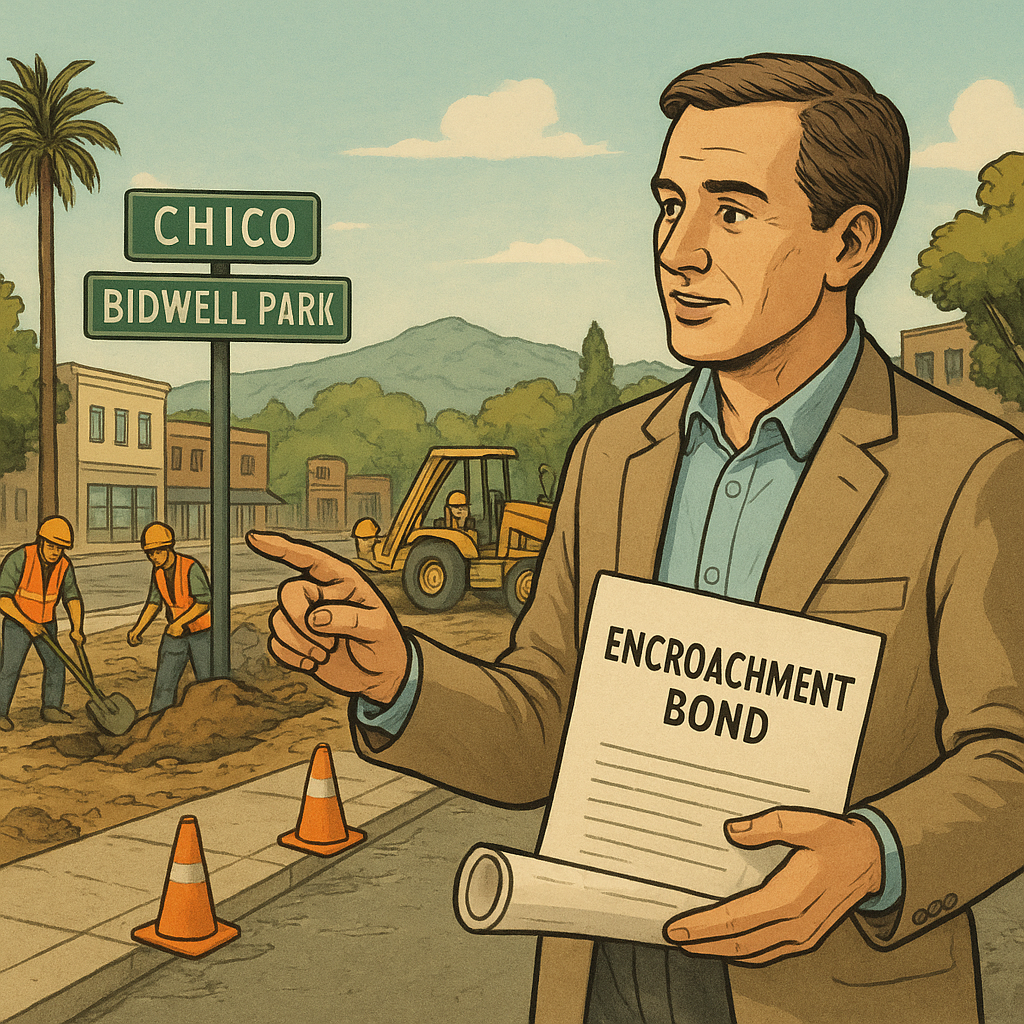
Whether you’re a long-time homeowner or new to the vibrant community of Chico, California, you might have heard the term “encroachment bond” tossed around at a city planning meeting or spotted it on a permit application. If it left you scratching your head, you’re not alone. Many residents don’t realize they need one until they’re about to start a project. Let’s break it down together and explore what the City of Chico CA Encroachment Bond really means for you, your property, and your neighbors.
What Exactly Is an Encroachment Bond?
Think of an encroachment bond as a promise you make to the city. In simple terms, it’s a financial guarantee that you’ll complete any work you do within the public right-of-way correctly and safely. The bond protects the City of Chico, California, making sure that if something goes wrong—like a sidewalk repair that cracks six months later, or a driveway that drains water onto the street—the city has funds to fix it without dipping into taxpayer money. It’s not a punishment. It’s more like a security deposit.
Imagine you’re borrowing a friend’s lawnmower. You might leave a small cash deposit to show you’ll return it in good condition. An encroachment bond works the same way. It tells the city, “I’ve got this, and there’s money set aside to prove it.”
Why Does the City of Chico Require a Bond?
The streets, sidewalks, curbs, and utility strips outside your home often belong to the public. We all use them every day. When a resident needs to dig up part of that public area to connect a sewer line, build a retaining wall, or even plant a tree, the city wants to make sure that area is restored to its original condition. Without a bond, the city would be on the hook for bad repairs that could become tripping hazards or drainage problems.
Chico cherishes its tree-lined streets and walkable neighborhoods. A Chico City Encroachment Bond helps preserve that charm. It’s a tool that encourages responsible construction and keeps our shared spaces looking good for years to come.
Protecting Everyone, One Bond at a Time
You might wonder, “Is this just red tape?” Not really. Think about a scenario where a contractor installs a beautiful new driveway but damages the public sidewalk in the process. If they don’t fix it, the homeowner might be left with a costly repair bill. If neither party steps up, the city has to step in. The bond creates accountability, ensuring that the person doing the work follows through. It’s a safety net that protects homeowners, contractors, and the entire community.
When Do You Need an Encroachment Bond in Chico?
Many everyday projects can trigger the requirement for an encroachment bond. You don’t need one for painting your house or swapping out a water heater indoors. But as soon as your project touches the public right-of-way, the city wants to be involved. Here are common examples:
- Installing a new driveway or widening an existing one that connects to the street.
- Replacing or repairing a public sidewalk, curb, or gutter next to your property.
- Adding a fence, wall, or landscaping feature that sits in the city’s front setback area or easement.
- Trenching across the street to connect to a main water, sewer, or gas line.
- Placing a temporary structure, like a dumpster or scaffolding, that blocks a sidewalk or parking lane.
If you’re unsure, just ask yourself: “Will any part of my project extend beyond my property line?” If the answer is yes, give the City of Chico’s engineering or public works department a quick call. They can confirm if your specific project needs a permit and a bond. It’s always better to check early than to pause your project mid-way.
How Does the Process Actually Work?
The process might sound intimidating, but it’s fairly straightforward once you know the steps. You don’t need a law degree to navigate it. Let’s walk through the typical journey a Chico resident takes.
Step 1: The Permit Application
Your first move is to apply for an encroachment permit from the City of Chico. You’ll describe your project, provide drawings or plans, and show where the work will happen relative to the public right-of-way. City staff will review your plans to make sure everything meets safety and design standards.
Step 2: Bond Amount Determination
Once the city approves your permit, they’ll calculate the bond amount. This figure is based on the estimated cost to repair the public area if something fails. For a small sidewalk section, the bond might be just a few thousand dollars. For more extensive street trenching, it could be higher. The city wants enough coverage to complete a full restoration, not just a patch job.
Step 3: Securing the Bond
You don’t have to front the entire bond amount in cash. Most people obtain a surety bond through an insurance company or bonding agency. You pay a small percentage of the total bond amount—often 1% to 3%—as a premium. So if your bond is set at $5,000, you might only pay $50 to $150 out of pocket. That’s much more manageable. The bonding company then guarantees the full amount to the city on your behalf.
Step 4: Getting to Work
With the permit in hand and the bond secured, you can start your project. The city might send an inspector to check on progress, especially if you’re working near traffic. Once the work is completed and passes inspection, you’re almost in the clear.
Step 5: The Waiting Period and Release
Here’s a part many people don’t expect. The bond doesn’t disappear the day the concrete sets. The city typically holds it for a warranty period, often one year. This gives everyone time to see how the new work holds up through rain, sun, and daily wear. If no defects appear, the bond is released, and your obligation ends. If something does fail, the city can use the bond to hire a contractor to fix it. Then you’d simply reimburse your bonding company—much easier than facing a surprise city bill.
What If You Skip the Bond?
It’s tempting to think, “No one will notice a small patch of sidewalk.” But the consequences can snowball. The City of Chico, California can issue a stop-work order, hold up your final permit approval, or even levy fines. If someone trips and gets hurt because of unpermitted work, you could be facing legal liability far beyond the cost of a simple bond. A little paperwork upfront can save immense headaches down the road.
Common Questions Residents Ask
Over the years, Chico homeowners have raised some excellent questions. Let’s tackle a few of the big ones.
“Can I use my own contractor’s bond instead?”
If your contractor has a valid license and their own bonding, you might think that covers you. However, the city requires a direct bond tied to your specific permit. Your contractor’s general license bond isn’t the same as an encroachment bond. Always clarify who will secure the required bond before signing a contract—it could be you or the contractor, but it must be in place.
“How long does it take to get a bond?”
Most bonding agencies can issue a bond within a day or two, especially if you have decent credit. It’s rarely a bottleneck. The bigger time factor is the permit review itself, which moves at the city’s pace.
“Does the bond cover my entire project or just the public part?”
The bond only covers work done in the public right-of-way or easement. Your private driveway, walkway, or landscaping on your own property is not included. That’s a relief, because it keeps the bond amount focused and affordable.
Making Sense of Chico’s Approach to Public Spaces
Chico isn’t uniquely strict—many California cities require similar bonds. But Chico’s commitment to safe, beautiful neighborhoods makes the bond process especially meaningful. Think of the beloved bike paths, the tree canopies on Esplanade, or the cozy sidewalks near downtown. These shared assets need care. The Chico City Encroachment Bond is simply a tool to maintain that quality of life for everyone.
If you’re a visual person, picture a patchwork quilt. Each homeowner’s project is one small square. If any square is stitched poorly, the whole blanket can pull apart. The bond ensures your square is sewn tight, keeping the neighborhood quilt intact for your family and your neighbors.
Tips for a Smooth Encroachment Bond Experience
A little preparation goes a long way. Keep these pointers in your back pocket when you’re ready to start that driveway or fence project.
- Talk to the city early. Before you dig, before you design, even before you hire a contractor. Knowing the requirements upfront prevents costly redesigns.
- Work with a reputable bonding agency. Ask your contractor or local insurance agent for recommendations. A quick online search for “Chico encroachment bond” will bring up specialists familiar with California municipal bonds.
- Keep your paperwork organized. Save your permit, bond certificate, and inspection notes. When it’s time to release the bond, you’ll have everything handy.
- Don’t rush the warranty period. Walk your project in different weather. Look for cracks, uneven settling, or drainage pooling. Report any concerns before the bond expires so you’re not footing the bill years later.
The Bigger Picture for Chico Residents
At its core, the encroachment bond is about shared responsibility. Our homes are our castles, but the pathways that connect them belong to all of us. When you take on a project that brushes up against public land, you’re stepping into a role of community caretaker. The bond is simply a formal way of saying, “I’ve got this, and I’ll leave it better than I found it.”
So next time you hear the term at a block party or see it on a city form, you can smile knowingly. It’s not a mysterious hurdle. It’s a promise—a small, one-time investment that keeps Chico’s streets safe, its sidewalks whole, and its neighborhoods beautiful. And who knows? Maybe you’ll be the one explaining it to a curious neighbor.