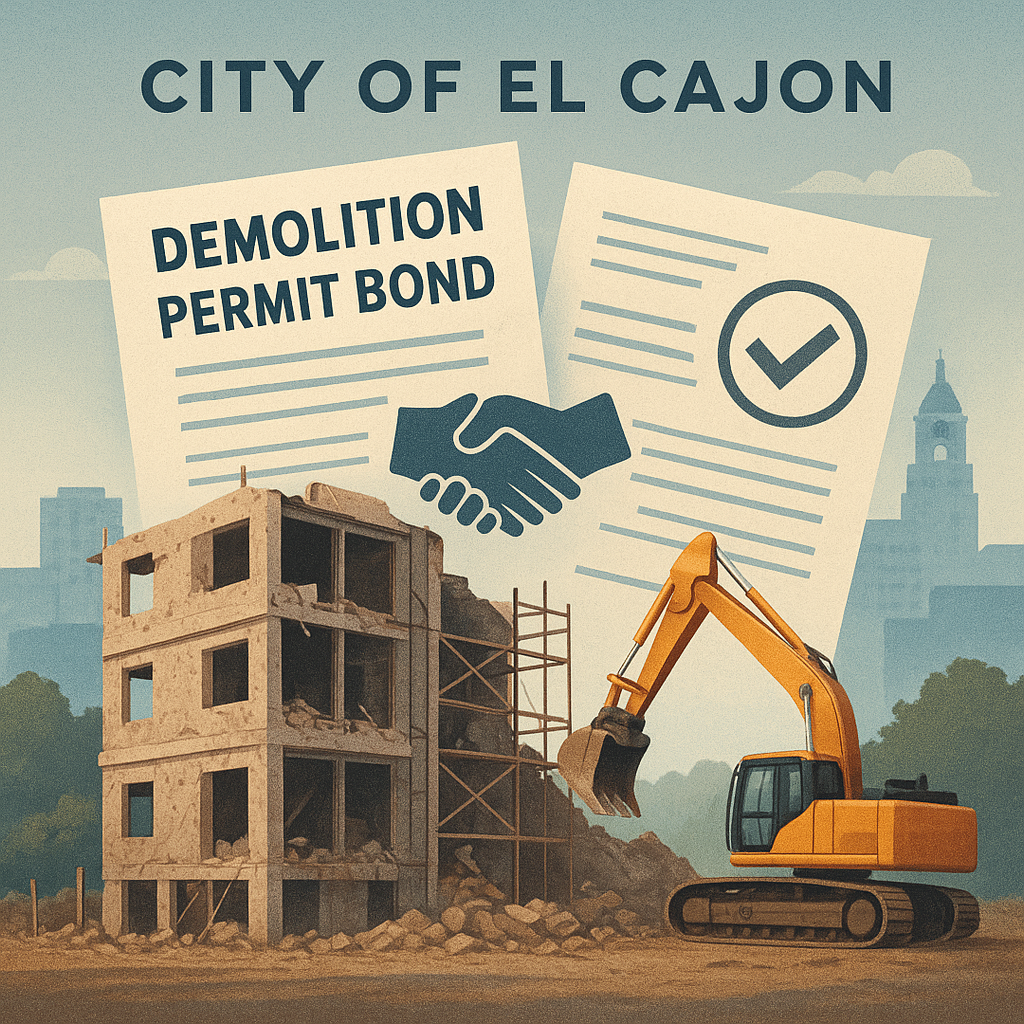
So, you’re planning a demolition project in the heart of San Diego’s East County. Maybe you’re finally tearing down that old, unstable garage, clearing a lot for a fresh start, or doing a full-scale commercial teardown. You’ve squared away the blueprints, hired a contractor, and headed to the City of El Cajon for your permits. Then they mention something that stops you in your tracks: a Demolition Permit Bond.
If you’ve never heard of it, don’t worry. You’re not alone. The phrase might sound a little intimidating, like some cryptic insurance policy. But truthfully, it’s a simple, straightforward promise designed to protect everyone’s best interests—including yours. Think of it as a safety net the city asks you to string up before you start swinging that wrecking ball.
What Exactly Is a Demolition Permit Bond?
Let’s break it down without the legalese. At its core, a demolition permit bond is a three-party agreement. The City of El Cajon (the obligee) requires you, the contractor or property owner doing the work (the principal), to purchase a bond from a surety company (the surety).
Now, what does this bond actually promise? It guarantees that you’ll follow all local rules, building codes, safety regulations, and the specific conditions printed on your demolition permit. It’s your financial vow that you won’t leave a dangerous hole in the ground, damage public utilities, or slap the city with an expensive cleanup bill. If you do everything by the book, the bond dissolves once the job is done and the city gives you the green light. If you don’t, there’s a fund available to fix what went wrong.
Why Does the City of El Cajon Require This Bond?
Imagine you’re a city official. You’re juggling public safety, underground utility lines, sidewalk stability, and the quiet enjoyment of an entire neighborhood. You can’t just hand someone a permit to knock down a building and hope for the best. You need a guarantee that the street won’t cave in, the asbestos won’t fly into the neighbor’s yard, and the site won’t become a magnet for illegal dumping.
That’s the bond’s whole purpose. El Cajon is a bustling community with a mix of historic homes, busy commercial corridors, and modern infill projects. Each demolition job is different. The city uses these bonds to shift the financial risk away from taxpayers and onto the person swinging the hammer. If a contractor bails halfway through a teardown and leaves a pile of debris blocking the street, the bond is there to pay for the city to step in and clean it up. You get to build, but the community stays covered.
How a Demolition Permit Bond Protects You (Yes, You!)
It’s easy to see how the bond protects the city and your neighbors. But how does it help you, the person paying for it? A lot, actually. First, it builds instant credibility. Homeowners want to hire someone who has already passed a financial background check with a surety company. It signals that you’re a pro who plays by the rules. Second, it keeps tiny misunderstandings from spiraling into courtroom drama. If a neighbor claims you cracked their driveway, the bond is a pre-funded way to handle legitimate damages without a messy lawsuit.
But there’s another layer. The bond gives you a clear rulebook. You know exactly what’s expected: protect the sidewalks, cap the utilities safely, haul away the debris, and grade the lot to proper drainage. Knowing the finish line helps you run a cleaner, faster, and more profitable job.
Who Needs a Demolition Permit Bond in El Cajon?
This is the part where many folks scratch their heads, thinking, “I’m just a homeowner tearing down a shed. Does this apply to me?” Generally speaking, if the City of El Cajon’s Building Division requires you to pull a demolition permit, you’ll likely need the bond as well. That covers:
- Licensed general contractors specializing in demolition or excavation.
- Property owners acting as their own contractor (often called owner-builders) for a small structure.
- Developers clearing a lot for new residential or commercial construction.
The threshold often depends on the scope of the work. Tearing down an entire single-family home? The bond is almost certainly required. Demolishing a tiny, detached tool shed that isn’t connected to utilities? You might be exempt, but you have to ask. The only way to know for certain is to talk directly with the City of El Cajon Building and Safety Department. They’ll give you the current requirements because nobody likes a surprise stop-work order.
Breaking Down the Cost: How Much Should You Budget?
Now for the question everyone really wants answered: “How much is this going to set me back?” The bond amount is set by the city. It’s often a specific dollar figure that represents the maximum the city can claim, not what you pay upfront. In many California cities, you might see bond amounts ranging from $5,000 to $25,000 for a standard residential demolition, but El Cajon’s requirements can vary based on the job’s complexity.
Here’s the good news: you don’t pay that full amount. You pay a small percentage, called the premium. For a solid contractor with good credit, the premium might be as little as 1% to 5% of the bond’s total value. So if the required bond is $10,000, you could pay somewhere between $100 and $500 for a term that covers the project. Factors that bump up your price include your personal credit score, business financials, and any past claims on your bond history. Think of it like this: the better your financial track record, the cheaper the promise gets.
The Step-by-Step Path to Getting Your Bond
Feeling ready to check this off your list? The process is much smoother than the demolition itself. You’ll follow a path that looks something like this:
- Get the official word from El Cajon. Visit the Building Division or their website. Confirm your project’s specific bond amount and any extra requirements like dust control measures or asbestos surveys.
- Contact a surety bond agency. Choose one that knows California demolition bonds well. They’ll walk you through an application—often a simple one-page form.
- Go through a quick underwriting review. The surety will peek at your credit and experience. For smaller bonds, this can happen almost instantly. Don’t panic if your credit isn’t flawless; many agencies offer programs for all credit profiles, just with adjusted pricing.
- Pay your premium and receive your bond form. This will be a legal document showing the city you’re covered.
- File the bond with the city. Take that original document to the permitting office. Once it’s filed and your permit is in hand, you’re cleared to start.
What Happens If Something Goes Wrong?
Let’s talk worst-case scenarios. Say a backhoe accidentally snags a gas line, or heavy truck traffic is damaging a public road the city hadn’t scoped for repair. A neighbor or the city itself can file a claim against your bond. The surety company will investigate. If the claim is valid—meaning you didn’t hold up your end of the permit agreement—the surety pays the city up to the full bond amount.
Here’s the part many folks misunderstand: the bond is not insurance for you. If the surety pays out $8,000 to repair a sidewalk you shattered, they will come back to you for full reimbursement. You’re on the hook for every penny they paid out. That’s why it’s so critical to handle your site with care, communicate with the city inspectors, and never, ever walk away from a half-finished demo. A claim doesn’t just hurt your wallet today; it can make it harder and more expensive to get bonded on your next job.
Demolition Bond vs. Insurance: Clearing Up a Common Mix-Up
People often use “bond” and “insurance” interchangeably, but they’re as different as a seatbelt and a savings account. Your general liability insurance protects you if an accident injures someone or damages property; the insurance company pays the claim and doesn’t expect you to pay them back. A bond, on the other hand, is a credit line extended to you. The surety pays the claim first, but they will absolutely exercise their right to collect from you later. The bond protects the public (and the city). Insurance protects you. You’ll typically need both for a fully covered demolition project in El Cajon.
Three Common Pitfalls to Dodge
Even seasoned contractors slip up sometimes. Here are a few bumps you can sidestep with a little planning:
- Assuming your contractor’s bond covers you. If you’re a homeowner hiring a crew, make sure their bond is valid and explicitly covers your specific address. Don’t let a contractor use a general obligation that might have lapsed.
- Forgetting to check bond expiration dates. These bonds usually cover the permit’s life. If your project gets delayed past the bond’s term, you’ll need to renew it before the city flags your permit.
- Ignoring the utility disconnection process. In El Cajon, you must coordinate with SDG&E and water authorities. Cutting a corner here is one of the fastest ways to trigger a claim if something gets damaged.
Ready to Start Digging?
A demolition permit bond isn’t a hurdle the city throws up to make your life difficult. It’s more like a handshake agreement that says, “We trust you to do a great job, and we’ve got a little backup in case things get messy.” Once you understand the “why,” the “how much,” and the “what if,” getting bonded becomes just another box to tick on your project checklist. Talk to the City of El Cajon, grab a quote from a reputable California surety agency, and move forward with the confidence that you’re building something new the right way.