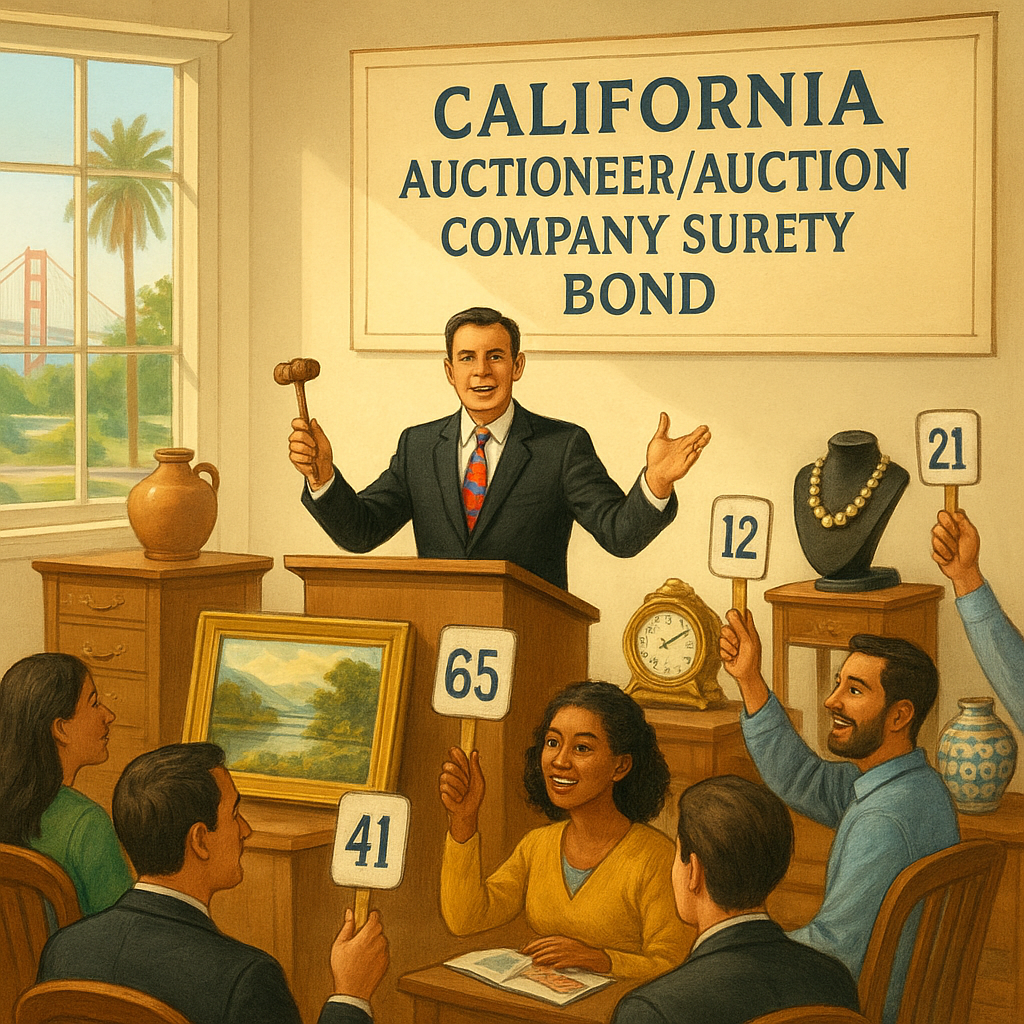
If you’re dreaming of calling bids at an art auction in Los Angeles, managing estate sales in San Francisco, or running an online auction platform from anywhere in the Golden State, there’s one piece of paper you’ll absolutely need—a California Auctioneer Surety Bond. But don’t let the formal name scare you. Think of this bond as your business’s promise to play fair, wrapped in a financial safety net for your clients.
What Exactly Is an Auctioneer Surety Bond?
Imagine you’re renting an apartment. The landlord asks for a security deposit. That money isn’t a fee you’ll never see again; it’s a safeguard. If you accidentally break a window, the landlord uses that deposit to fix it. If you leave the place spotless, you get the money back. A surety bond works kind of like that, but with a twist.
A California Auctioneer Surety Bond is a three-party agreement. There’s you, the auctioneer (the principal). There’s the state of California (the obligee), which requires the bond. Then there’s the surety company, which backs you financially. The bond guarantees that you’ll follow the state’s auction laws and handle other people’s money and property honestly. If you don’t, a client can make a claim against the bond to recover their losses. The surety company pays out first, but here’s the catch—you’re eventually responsible for paying them back.
Who Needs This Bond in California?
The short answer? Almost anyone who runs auctions other than livestock auctions. The state makes a clear distinction. If you’re auctioning cattle, horses, or other farm animals, you fall under a different category. But for everything else—antiques, fine art, business inventory, real estate, vehicles, charity events, storage units, you name it—you’ll need this specific bond before you can legally operate.
This requirement covers individual auctioneers as well as auction companies. So whether you’re a one-person show traveling to estate sales or a large auction house with a team of ringmen, the bond is non-negotiable. It’s a prerequisite for getting your license from the California Department of Industrial Relations, Division of Labor Standards Enforcement.
Why Does California Require a Bond for Auctioneers?
Let’s be honest: auctions involve a lot of trust. You’re handling someone’s prized possessions, collecting payments from buyers, and then disbursing funds to sellers. Money moves in multiple directions. Without a bond, there’s nothing stopping a bad actor from pocketing the proceeds and disappearing. California’s bond requirement creates a layer of financial protection for the public.
The state wants to make sure that if you sell a family’s heirloom for $10,000, that money actually reaches the family—minus your agreed-upon commission, of course. If something goes wrong, the harmed party can seek compensation without needing an expensive, drawn-out lawsuit. It’s a clever system that keeps the auction industry trustworthy and professional.
How Much Does an Auctioneer Bond Cost?
Let’s get to the numbers, because this is where many people breathe a sigh of relief. The bond amount required by California is $20,000. But that’s not what you pay. Think of it like a car insurance policy with a $20,000 coverage limit. You only pay a small percentage of that amount as a premium.
Most auctioneers pay between $100 and $250 per year for their bond, depending on their credit score and financial history. If you have excellent credit, you might land on the lower end of that range. Even with some credit blemishes, you can often still get bonded through programs designed for higher-risk applicants, though the rate might be a bit steeper. It’s a small investment to unlock your entire business potential.
Factors That Influence Your Bond Premium
Surety companies look at a snapshot of your financial responsibility. The main factors include:
- Your personal credit score. A higher score signals lower risk, leading to a cheaper premium.
- Your business financials. If you run an established auction company, the surety may consider your company’s revenue and stability.
- Your experience. Years in the industry can work in your favor, showing you know the ropes and are less likely to run into trouble.
- Any past bond claims. A clean history keeps costs down. A previous claim might raise a red flag.
Don’t let fear of the unknown stop you. Many bond agencies can quote you a price in minutes, often online, without a hard credit pull that dings your score.
How to Get Your Auctioneer Bond: A Simple Step-by-Step
The process is quicker than most people expect. Here’s a straightforward path from zero to bonded:
- Find a reputable surety bond agency. Look for one that specializes in license and permit bonds, especially for California businesses. You can work directly or through a broker.
- Complete a quick application. You’ll provide basic information about yourself and your business. Name, address, social security number (for a personal credit check), and the bond type you need.
- Receive your quote. Within as little as a few hours, you’ll get a premium amount. Review it, ask questions, and make sure you understand the terms.
- Pay the premium. Once you pay, the surety company issues your official bond form.
- File the bond with the state. You’ll receive the completed bond document. Submit it along with your auctioneer license application or renewal paperwork to the California Division of Labor Standards Enforcement.
And that’s it. You’re bonded and ready to start—or continue—calling auctions across California.
What Happens if Someone Files a Claim Against Your Bond?
Nobody likes to think about claims, but it’s wise to understand the mechanism. If a seller or buyer believes you’ve violated the law or breached your contract, they can file a claim with the surety company. The surety then investigates. If the claim is valid, the surety pays the harmed party up to the $20,000 bond amount.
Here’s the crucial part: a surety bond is not insurance for you. After the payout, the surety company will seek reimbursement from you for every penny paid out, plus any legal fees. In bond language, you indemnify the surety. That means you agree to hold them harmless and pay them back. So while the bond protects the public, it ultimately holds you accountable. Think of it as a powerful incentive to always do the right thing.
Keeping Your Bond Active and Avoiding Pitfalls
Your bond typically runs for a one-year term and must be renewed annually. Mark your calendar. Letting your bond lapse is a serious issue—it can lead to your auctioneer license being suspended or revoked, and you’d have to stop doing business immediately. Fortunately, the renewal process is usually even simpler than the initial purchase. Many agencies send reminders and allow you to renew online in minutes.
To avoid ever facing a claim, maintain crystal-clear records of every transaction. Use separate escrow accounts for client funds. Communicate openly with sellers and buyers about fees, payment timelines, and any hiccups. Most claims stem from misunderstandings that could have been resolved with a phone call or clear contract language. An ounce of prevention really does save a pound of cure here.
Does Your Business Structure Change the Bond Requirement?
You might wonder if forming an LLC or corporation shields you from needing an individual bond. The answer is no. The state requires a bond from the entity conducting the auction. If you own an auction company, the company itself holds the bond. If you’re a sole proprietor, you hold the bond personally. In some cases, a business might need to list multiple owners on the bond or obtain separate bonds for different corporate entities. When in doubt, ask your bond agency—they can help you navigate which name goes where.
The Bond in Action: A Real-World Example
Let’s paint a picture. Maria runs a small estate auction business in San Diego. She’s hired to liquidate a retired professor’s collection of vintage books and art. She auctions everything off over a weekend, collecting $15,000 from buyers. After deducting her commission, she owes the professor’s family $12,000. But a personal financial crisis strikes; Maria uses the money to pay her own rent, promising to repay later. She never does.
The family files a claim against Maria’s $20,000 auctioneer bond. The surety investigates, sees clear evidence of misappropriation, and pays the family the $12,000. Maria then owes the surety company $12,000, plus possible legal costs. The bond didn’t erase Maria’s mistake, but it saved the family from a total loss. For every honest auctioneer, this system provides confidence to clients that they’re dealing with a bonded professional who has skin in the game.
Common Questions About California Auctioneer Bonds
Can I get bonded with bad credit?
Yes, it’s possible. Some surety companies work with what’s called “non-standard” or “high-risk” markets. Your premium will be higher, perhaps $250 to $500 per year, but you can usually still get the bond you need. It’s far better than operating without one and risking huge fines or legal trouble.
Is this bond the same as business insurance?
Not at all. A bond protects the public and the state; it does not protect your business from losses or liabilities. You’ll still want liability insurance, property insurance, or an errors and omissions policy to cover your own risks. The bond and insurance serve entirely different purposes.
What if I only auction items online?
Even internet-only auctions fall under California’s regulations if you or your business operate from the state. The bond requirement isn’t about the physical location of the auction block; it’s about the handling of other people’s property and money as an auctioneer. So yes, online auctioneers also need this surety bond.
Taking the Next Step Toward Your Auction Career
Obtaining a California Auctioneer Surety Bond for non-livestock auctions is a straightforward, affordable process that establishes your credibility from day one. It tells sellers, buyers, and the state that you’re committed to ethical business practices. Rather than viewing the bond as just another bureaucratic hurdle, see it as a badge of professionalism. When you’re bonded, you’re signaling that you stand behind your word—and that’s the foundation of a lasting auction business.
Start by reaching out to a licensed surety bond provider. In the time it takes to watch a movie, you can have a quote in hand and be well on your way to checking this requirement off your list. Then you can focus on what you do best: bringing hammer down on great deals and making exciting sales happen.