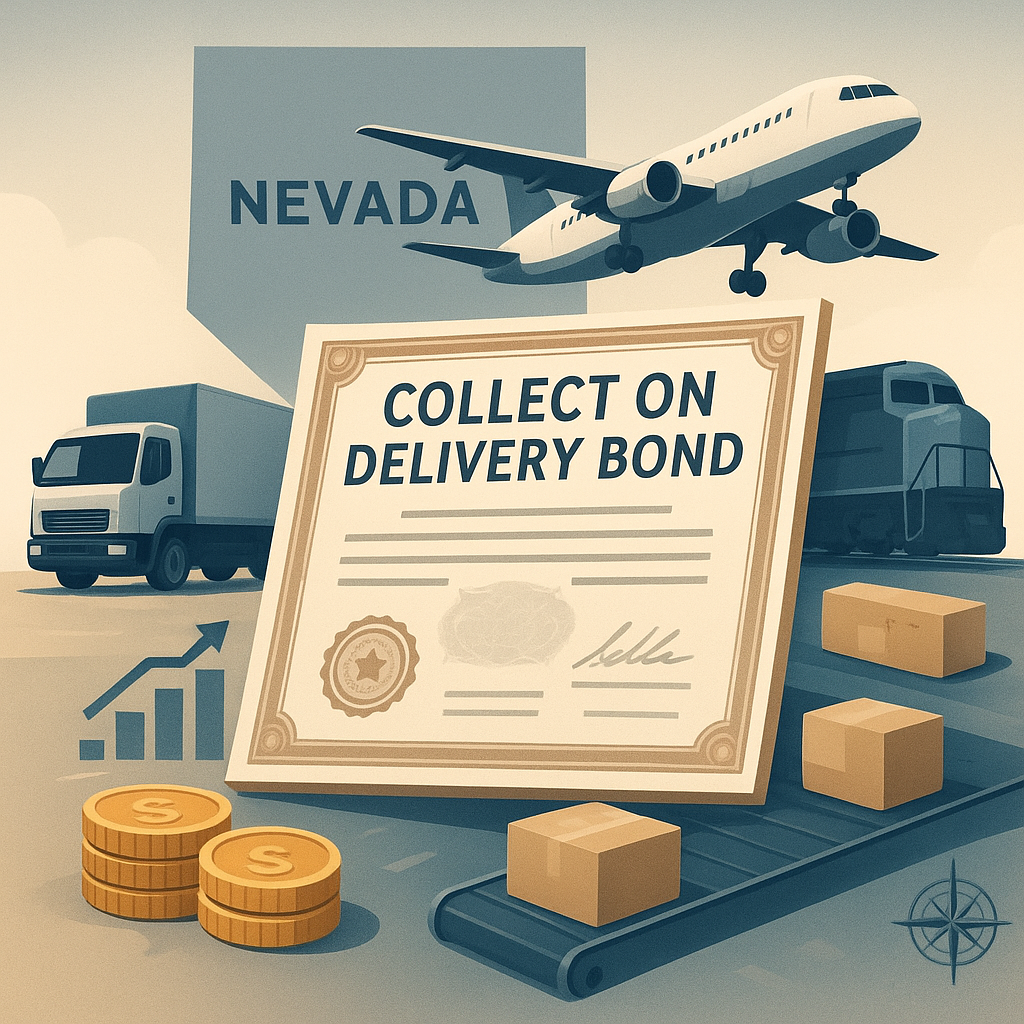
You know that moment when you order something online and choose to pay cash when it arrives? That’s the beauty of Collect on Delivery, or COD. It’s a promise. The customer hands over the money, the delivery driver accepts it, and everyone walks away happy. But what happens if that money never makes it back to the seller? In Nevada, that’s where a special kind of financial safety net comes into play. Let’s pull back the curtain on the Nevada Collect on Delivery Bond and see why it matters to shippers just like you.
What Exactly Is a Nevada Collect on Delivery Bond?
Think of it as a protective shield. A Nevada Collect on Delivery Bond is a type of surety bond required by the State of Nevada for certain carriers who handle COD shipments. It’s not insurance for your truck or cargo. Instead, it’s a three-party guarantee. You, the shipper or carrier, promise to play by the rules. The state requires that promise to be backed up by a bond. If you break that promise — say by collecting cash from a receiver and then “forgetting” to forward it to the shipper — the bond kicks in. The hurt party can make a claim, and the bonding company covers the loss up to the bond amount.
It might sound a little dry, but imagine a security deposit on an apartment. The landlord holds it to make sure you don’t damage the place. In the COD world, the bond acts as a security deposit with the state, showing everyone you’re serious about honest money handling.
Why Does Nevada Require This Bond?
Nevada isn’t being difficult. The state wants to protect businesses and consumers from financial headaches. COD transactions involve real money moving from a receiver, through a driver, and back to a warehouse or shipper. That chain has a tempting weak link — the person collecting the payment. Without a bond, a shipper in Reno might send out ten deliveries, and if a carrier disappears with the collected funds, the shipper is left holding the bag. The bond requirement keeps the playing field honest and gives shippers a clear path to recovery.
Who Needs to Worry About This Bond?
Not every delivery truck rolling down the strip needs a COD freight bond. This requirement generally applies to motor carriers and freight forwarders operating within Nevada who provide COD services. If your company picks up a package, collects payment upon delivery, and then remits that money back to the consignor, you’re very likely reading this because you need a bond.
Are you an independent owner-operator hauling COD loads? A small courier service that handles cash-on-delivery envelopes? Even larger logistics companies that dabble in COD freight can fall under the same umbrella. When in doubt, checking with the Nevada Transportation Authority (NTA) is a smart move. But think about it this way: if your business model involves handling other people’s money at the doorstep, a bond is your new best friend.
A Simple Rule of Thumb
Does your service involve both transporting goods and collecting the payment for those goods? If yes, Nevada likely wants you bonded. It’s as straightforward as that.
How Does the Bond Actually Work?
Let’s walk through a real-world scenario. Picture a furniture maker in Las Vegas. They craft a custom table and ship it COD to a buyer in Elko. They hire your trucking company to make the delivery and collect the $2,000 payment. You do the delivery, the buyer hands over the cash, and you’re supposed to turn that money over to the furniture maker within a set number of days. But what if a week goes by and the furniture maker hasn’t seen a dime? Frustration mounts.
If your company holds a Nevada Collect on Delivery Bond, the furniture maker can file a claim against it. The surety company investigates. If the claim is valid, they pay the furniture maker up to the full bond penalty. Then — and this is crucial — they come back to you for reimbursement. A bond is not a get-out-of-jail-free card. It’s essentially a line of credit you must repay. You’re still 100% responsible for any money you owe.
This system keeps trust alive. Shippers feel safe giving COD loads to bonded carriers. Carriers prove their reliability. The state stays happy by regulating the process.
How Much Does a Nevada COD Bond Cost?
Here’s some good news you might be holding your breath for. You don’t need to shell out the full bond amount from your own pocket. The state sets the required bond amount, which can vary based on your operations, but let’s say it’s a $10,000 bond. You won’t pay $10,000 upfront. Instead, you pay a small percentage, called the premium. For many shippers with decent credit, this premium falls somewhere between 1% and 5% of the total bond amount.
So, a $10,000 bond might only cost you $100 to $500 per year. That’s a manageable expense, especially compared to the risk of losing a big contract or facing a lawsuit over missing COD funds. Even if your credit isn’t sparkling, options like credit repair programs or slightly higher premiums are often available. The cost is a tiny price for the credibility it buys you.
Steps to Secure Your Bond Quickly
Ready to get bonded and back on the road? The process doesn’t have to be a maze. Follow these simple steps, and you’ll be holding your bond in no time.
- Know Your Requirement. Double-check the exact bond amount and form mandated by the Nevada Transportation Authority. They’ll tell you the required penal sum.
- Find a Trustworthy Surety Agency. Look for an agency that specializes in freight or transportation bonds. They’ll speak your language and speed up the process.
- Complete a Quick Application. You’ll supply basic business details, sometimes personal information, and consent to a credit check. This isn’t an invasive process for small bonds.
- Get Your Quote. The surety reviews your application and credit. If all looks good, you’ll receive a premium quote almost instantly.
- Pay the Premium and Sign. Once you pay the annual fee, the bond is issued. You’ll typically get a digital copy right away.
- File with the State. Send the original bond form to the NTA. Your obligation is complete, and you’re officially compliant.
It’s a lot like getting a cell phone plan — a little paperwork up front, and then you enjoy the benefits month after month.
Real Benefits of Being Bonded
Beyond just checking a box on a state form, holding a Nevada Collect on Delivery Bond does wonders for your business reputation. When a shipper is deciding between two carriers, the bonded one almost always wins. That little piece of paper says, “I’m financially responsible and I’m accountable for the money I handle.” It’s a trust signal louder than any advertising slogan.
Also, it protects your business from unexpected pitfalls. A rogue employee or a simple accounting mix-up could lead to a shortage of collected funds. The bond provides a mechanism to resolve disputes before they blow up into massive legal battles. It’s like having a pre-agreed mediator who can make things right financially, keeping your business relationships intact.
Common Pitfalls and How to Dodge Them
We’ve seen shippers stumble a few times. The most frequent mistake is mixing up COD bonds with cargo insurance or motor carrier bonds. They’re totally different animals. A cargo policy covers lost or damaged freight. A COD bond covers collected money that isn’t remitted. You might need multiple bonds and policies to be fully protected.
Another headache? Letting the bond lapse. If you forget to renew, you’re instantly out of compliance. The state could slap you with fines or suspend your authority to operate. Set a calendar reminder a month before your bond’s anniversary. Better yet, most surety agencies will send you renewal notices. Treat them like gold.
Finally, always keep pristine records. If a claim hits your bond, solid documentation of remitted payments can save you. Write down every envelope, every cash amount, every money order. In a dispute, your paperwork is your superhero cape.
What If a Claim Gets Filed Against You?
It’s a scenario nobody wants, but it’s manageable. First, don’t panic. A claim doesn’t mean you’ve lost the battle. Contact your surety company immediately. They’ll investigate exactly what happened. If you’ve done nothing wrong, you provide your evidence, and the claim may be dismissed. If you did make an error, it’s often cheaper and less stressful to resolve it directly with the claimant before the surety pays out. Remember, you owe the surety back for any payout, so a fast settlement can keep your costs down and your future premiums low.
Nevada COD Bond Versus Other State Requirements
If you’re hauling interstate, you might wonder how Nevada stacks up. Every state has its quirks. Some states don’t require a COD bond at all. Others demand higher amounts. Nevada’s approach is consumer-friendly without being overbearing. The bond amount is typically reasonable, making it accessible for small carriers and not just the big players. That levels the playing field, so a family-run courier in Henderson can compete with national giants.
Putting It All Together
Navigating the world of surety bonds might seem daunting at first, but the Nevada Collect on Delivery Bond is really just a tool for building trust. It protects your customers, polishes your professional image, and keeps you on the right side of the law. Without it, you’re a ship without an anchor — drifting and at risk. With it, you’re a solid, bonded partner ready to handle cash deliveries with confidence.
So, next time a potential client asks if you’re bonded for COD shipments, you can answer with a proud “Yes!” and back it up. That’s the kind of peace of mind that turns one-time shippers into long-term partners. If you’re ready to get your bond or just have more questions, reach out to a knowledgeable surety professional. The road ahead is a lot smoother when your finances are protected.