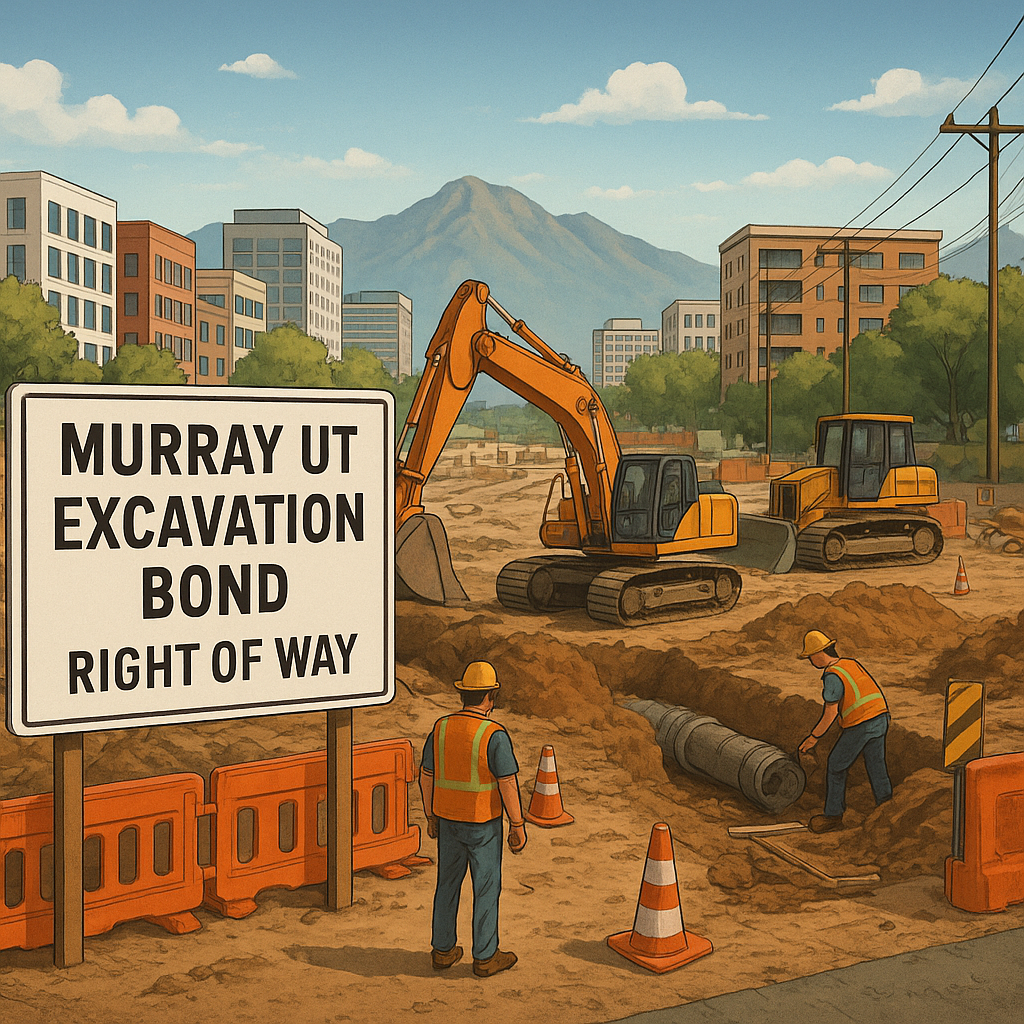
You’re about to dig into a curb, cut open a street, or trench through a sidewalk in Murray City, Utah. It’s an exciting step — maybe you’re connecting utilities to a new home, repairing a water line, or installing fiber optic cable. Then someone mentions you need an excavation bond for the right of way. Suddenly, excitement can turn into confusion. What exactly is that? Why does Murray City require it? And how do you get one without pulling your hair out?
Take a deep breath. This guide breaks it all down in plain, friendly language. By the time you finish reading, you’ll understand excavation bonds for the Murray City right of way, why they matter, and how to handle them like a pro.
What Is an Excavation Bond, Really?
An excavation bond is a promise. Think of it like a security deposit you might leave when renting an apartment — except instead of covering potential damage to the unit, it covers the ground beneath our feet. When you dig in the public right of way (the strip of land between private property lines, often including sidewalks, parkways, and streets), you’re working in a space owned by the city or the public. Murray City wants to ensure that after you open up the earth, lay pipes, or set conduits, you’ll put everything back just as you found it — or better.
If you don’t restore the area properly, the bond money steps in to fix it. The bond isn’t insurance for your equipment or your crew; it protects the city and its residents from incomplete or shoddy restoration work. Simple enough, right?
Why Murray City Cares About the Right of Way
Imagine your neighborhood street after a long winter. Potholes, cracks, and sunken patches already test your car’s suspension. Now picture a contractor digging a trench across the road for a sewer repair and then just patching it with a lump of asphalt that sinks six months later. Frustrating, isn’t it? Murray City wants to avoid that scenario entirely.
The right of way isn’t just empty space. It’s where utilities run like underground rivers — water, sewer, gas, electric, telecom. It’s also where pedestrians walk and cyclists ride. Any excavation here can disrupt daily life and, if repaired poorly, become a long-term hazard. The bond requirement incentivizes contractors, homeowners, and business owners to follow the specifications set by the city. It’s a motivation to compact the soil correctly, match the existing pavement, and restore landscaping to city standards.
Who Actually Needs This Bond in Murray City?
You might think only giant construction companies need a bond, but the net is wider. You’ll likely need a Murray City UT excavation bond if you plan to:
- Dig up any portion of a public street, alley, or sidewalk.
- Trench through a parkway (the grassy strip between the curb and sidewalk) to install or repair utilities.
- Create a new driveway approach that requires cutting into the curb or sidewalk.
- Perform any underground utility work that disturbs the public right of way, even if your property is private.
Homeowners taking on a DIY project to replace a sewer lateral often fall into this category. Contractors bidding on public works or utility extensions certainly do. If you’re unsure, a quick call to the Murray City Public Works or Engineering Department can clarify your specific project. They’re generally quite helpful — nobody wants you to start digging without permission.
The “Right of Way” Jargon, Explained
“Right of way” sounds like a legal puzzle, but it’s easier to picture than you think. Stand at the edge of your front yard and look toward the street. The sidewalk, the grassy strip, the curb, and the asphalt roadway are typically located within the public right of way. It’s basically an easement that allows the public (and utility companies) to access and use that space, even if it feels like part of your property. Murray City maintains control over what happens there because it’s shared community space. When you excavate here, you’re a temporary guest, and the bond is your cleanup deposit.
How an Excavation Bond Protects Everyone
Let’s follow a story. Suppose a plumber cuts a neat trench across a quiet Murray neighborhood street to fix a broken water main. The repair takes two days, and they backfill the trench, pack down the gravel, and apply a temporary asphalt patch. The bond money sits with the city as a guarantee that the plumber will return to install the permanent asphalt cap within a set time, maybe thirty days. If they vanish, or if their permanent patch fails inspection because the grade is off, the city can use the bond funds to hire another crew and fix it right. That means you, the taxpayer, don’t foot the bill. The bond also gives the city a straightforward way to enforce standards without chasing down contractors in court.
Different Flavors of Excavation Bonds
Not all jobs are the same size, so bonds come in different shapes. You might encounter:
- Single project bonds: Covers one specific job. Once the work passes final inspection and the warranty period ends, the bond is released.
- Blanket bonds: Ideal for contractors who do frequent right-of-way work in Murray City. Instead of pulling a new bond for every small trench, they secure a larger bond that covers multiple projects over a year. It’s like having an umbrella policy — efficient and time-saving.
- Cash bonds: Some smaller jobs might allow you to post a cash deposit with the city instead of a surety bond. The funds are returned after satisfactory restoration. It’s straightforward but ties up your cash.
Murray City typically works through a combination of these, and the engineering department can guide you to the right type based on your scope of work.
How Much Does the Bond Cost?
Here’s where people get pleasantly surprised. The bond is not an upfront tax-like expense that disappears. The cost to you is the premium you pay to a surety company, which is usually a small percentage of the total bond amount. The bond amount itself is set by Murray City — often based on the square footage of excavation, the type of surface being cut, and the estimated restoration cost. A small sidewalk cut might require a bond of $2,000 or $5,000. A major street excavation could push the bond requirement to $25,000 or more.
If you have good credit and some business history, your premium might be as low as 1% to 3% of the bond amount. That means a $10,000 bond could cost you only $100 to $300 out of pocket. Even homeowners with less-than-perfect credit can often secure a bond, though the rate might be slightly higher. The key is understanding that the bond amount is not your fee — the premium is. Compare it to a rental car deposit hold: the company puts a hold on $500 on your credit card, but you actually pay nothing as long as you return the car undamaged. Here, you pay a small, non-refundable premium instead of a full hold.
Step-by-Step: Getting Your Murray City Excavation Bond
The process doesn’t need to be daunting. In most cases, it follows a logical path:
1. Start with the City
Before any digging, you’ll likely need a right-of-way permit from Murray City. The permit application will spell out the bond requirement. You’ll learn the exact bond amount and any special conditions (like a longer warranty period for certain cuts).
2. Contact a Bond Provider
You can work directly with a surety bond agency or through an insurance broker who offers surety bonds. Give them the bond form from the city. They’ll ask a few simple questions — business name, owner details, bond amount, and sometimes a soft credit check for larger bonds. It’s quick, often doable within the same business day.
3. Pay the Premium
Once approved, you pay the premium, and the agency issues the bond. They’ll provide a document that you submit to Murray City along with your permit application (or before the permit is officially issued).
4. Do the Work and Get Released
After your excavation and restoration pass city inspection, you’ll request a bond release. For a single project bond, this usually happens after the final sign-off. For blanket bonds, the bond remains active until the renewal date or until you stop performing work in the city.
Common Pitfalls and How to Dodge Them
Many delays happen because someone skips the homework. For instance, a homeowner may hire a contractor, assuming the contractor handles all permits and bonds, only to discover the permit is in the homeowner’s name and the bond is missing, stopping work halfway. Always ask: “Who is responsible for securing the right-of-way permit and bond?” Get it in writing.
Another trap: underestimating restoration standards. Murray City can require that concrete cuts match the existing pattern, that asphalt patches be saw-cut to clean lines, and that landscaping return to a lush state. If your patch sinks because you didn’t compact properly, the city may call on the bond to fund redoing it. That can delay your bond release and sour your relationship with the city. Do the job right the first time, and the bond sails through release without drama.
Frequently Asked Questions, Asked by People Just Like You
“Can I just add a right-of-way bond to my existing contractor’s insurance?”
No, it’s a separate product. General liability insurance covers things like accidentally hitting a gas line and causing a fire. The bond specifically guarantees the restoration of the right-of-way surface. They complement each other, but you need both.
“What happens if my bond claim gets called?”
If the city uses the bond because your work failed, they file a claim with the surety company. The surety pays the city, and then comes to you for reimbursement. It’s not free money — you remain ultimately responsible. That’s why it’s crucial to meet the standards.
“Do I need a bond for work on my own driveway apron?”
If the apron is within the public right of way (and most are), yes. Many homeowners are surprised by this. But think about it: the apron connects your property to the public street, and if it’s poorly constructed, it can create drainage issues or trip hazards for pedestrians. The bond safeguards that edge of the public realm.
Why This Little Bond Matters Big Time
At first glance, an excavation bond for Murray City right-of-way might feel like paperwork overkill. But when you look at it from the community’s perspective, it’s a small, smart tool that keeps streets smooth, sidewalks safe, and the neighborhood looking good. It ensures that when you dig, you’re also committing to restore. That’s a fair deal.
So whether you’re fixing a sewer line, running power to an ADU, or installing that gig-speed internet everyone’s been waiting for, respect the right of way. Grab your permit, secure your bond, and dig with confidence knowing you’ll leave Murray City just as beautiful as you found it.