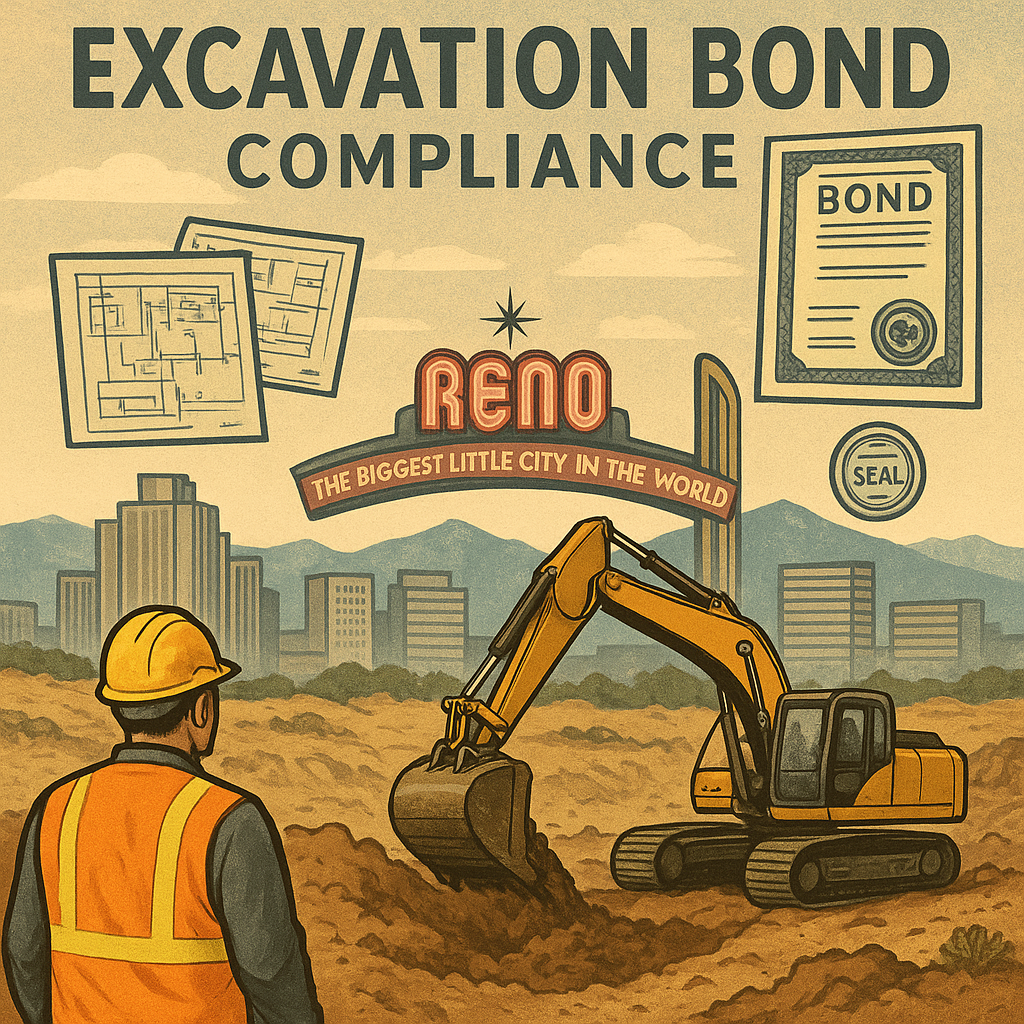
Picture this: You’ve just landed a solid contract to dig footings for a new patio in a quiet Reno neighborhood. The sun is shining, your crew is ready, and the equipment is humming. You start scooping earth — and suddenly, you nick a buried gas line. In the blink of an eye, the job site turns into an emergency zone, the street gets shut down, and the city is knocking on your door. It’s every excavation contractor’s nightmare, and it’s exactly the kind of situation the City of Reno wants to prevent.
If you’re an excavation contractor turning dirt anywhere in Reno, Nevada, you’ve probably heard the term “excavation bond” floating around. Maybe you’ve wondered, “Is this just another piece of red tape, or does it actually matter?” Let’s walk through what this bond is, why the City of Reno requires it, and how staying compliant can save your business — and your reputation — from a world of hurt.
What Exactly is a Reno Excavation Bond?
Think of a Reno excavation bond as a financial promise wrapped in a three-party agreement. The City of Reno (the obligee) asks you, the excavation contractor (the principal), to buy a bond from a surety company. If you fail to follow city rules while excavating, especially in public right-of-way areas, the city can turn to that bond for money to fix any damage you caused. It’s similar to a security deposit — you’re setting aside a guaranteed pot of money to prove you’ll play by the rules.
But hold on. A bond is not insurance, and that’s a big mistake many contractors make. Insurance protects your business if something goes wrong. A bond protects the city and the public. If a claim is paid out on your bond, the surety company will come back to you for every penny. So this isn’t just paperwork — it’s a real financial responsibility.
Why Does the City of Reno Require an Excavation Bond?
Every time you break ground in Reno’s streets, sidewalks, or utility easements, you’re working in spaces that belong to everyone. Under those layers of asphalt and dirt lie a web of water mains, sewer lines, fiber optic cables, and gas pipes. One wrong move with a backhoe can knock out internet for an entire block or cause a gas leak that forces families from their homes. The city’s bonding requirement does two very important things:
- It encourages careful work. Knowing you’re financially on the hook for mistakes pushes you to call 811, double-check utility maps, and follow safe digging practices.
- It provides a ready safety net. If something does go sideways, the city doesn’t have to chase you down in court to repay the cost of repairs — they can file a claim against your bond and get the work fixed fast.
In a nutshell, this bond tells the City of Reno, “You can trust me to put things back exactly the way I found them — or better.”
Who Needs an Excavation Contractor Bond in Reno?
You might be thinking, “I only do small residential jobs in backyards. Do I really need a bond?” The answer isn’t a one-size-fits-all, but here’s a straightforward way to look at it. If your excavation work touches the public right-of-way — think streets, alleys, sidewalks, curbs, gutters, or any utility line that sits under a public road — you almost certainly need a Reno NV excavation bond. This applies to a wide range of work, from trenching for a new water service to cutting a street to repair a sewer lateral. Even if your project starts on private property, any connection to city services usually requires a permit and a bond.
On the other hand, strictly on-site private excavation that never leaves the property line and doesn’t involve publicly maintained utilities might not trigger the bond requirement. However, the City of Reno’s public works department evaluates each permit application. It’s always safer to ask before you dig, and definitely before you assume you’re exempt. The phrase “excavation contractor – compliance only” often appears in bond records to clarify that this bond is about following municipal rules, not about the quality of your building work itself.
How the City of Reno Excavation Bond Works in Real Life
Let’s bring this down to earth with an everyday example. Say you’re replacing a water line for a coffee shop on Wells Avenue. You obtain the necessary excavation permit from the City of Reno and, as part of that process, post your excavation bond. Two days into the job, your crew accidentally cracks a sewer main connected to the shop next door. Sewage starts backing up, the sidewalk gets torn up for emergency repairs, and the city sends out a repair team. That repair bill lands on the city’s desk — and because the damage happened during your permitted excavation, the city can file a claim against your bond. The surety pays out up to the bond’s limit to reimburse the city, and you then have to repay the surety for every dime.
Without the bond, the city might have to use taxpayer money for emergency fixes and then sue you to recover costs. It’s a messy, expensive, and reputation-crushing route nobody wants to travel. The bond keeps the process clean, fast, and businesslike.
What Amount Does the Bond Need to Cover?
Bond amounts aren’t pulled from thin air. The City of Reno sets the required bond amount based on the scope of work, the square footage of trenching, or the potential impact on public infrastructure. Smaller residential tie-ins might need a $5,000 bond, while major commercial digs could require $25,000 or more. Before you buy a bond, the city will tell you exactly how much coverage you must carry to pull your permit. Working with a surety bond agency that knows Reno’s municipal requirements is a smart move — they can help you purchase the right amount quickly so you aren’t stuck waiting.
The Steps to Getting Your Reno NV Excavation Bond
Luckily, securing a City of Reno excavation bond is not a complicated maze. Most contractors can get bonded within a single business day. Here’s the typical path:
- Talk to the City First. Check with Reno’s public works or building department to confirm that your project requires a bond and to find out the exact bond amount you need.
- Reach Out to a Surety Bond Provider. Search for an agency that specializes in contractor bonds in Nevada. They’ll understand the local landscape and required forms.
- Fill Out a Quick Application. You’ll provide basic information about your business, and in many cases, the provider will run a soft credit check. Don’t sweat it — even contractors with less-than-perfect credit can often get bonded through special programs.
- Pay the Premium. You won’t pay the full bond amount upfront. Instead, you pay a small percentage — often between 1% and 10% of the total bond. So a $10,000 bond might cost you only $100 to $1,000 for the year.
- File the Bond with the City. Once you have the bond in hand, present it to the City of Reno as part of your permit package. The city will keep it on file for the life of your permit, and often for a set period after the work is complete.
Common Pitfalls and How to Avoid Them
Staying compliant doesn’t end when you hand over the bond paper. Here are a few traps that can trip up even seasoned excavation contractors:
Letting the Bond Lapse. Most bonds run on a term, usually one year. If your project runs long, you might need to renew the bond. An expired bond with an open permit can bring your work to a dead stop and trigger penalties. Put a reminder in your calendar a month before expiry.
Not Understanding Right-of-Way Restoration Standards. The City of Reno has very specific rules about how pavement, sidewalks, and landscaping must be restored after trenching. A lumpy patch job might prompt a claim even if the underground work was flawless. Read the restoration guidelines early, and factor that finish work into your bid.
Assuming All Surety Bonds Are the Same. The “City of Reno NV Excavation Bond” is not interchangeable with a general contractor license bond or a state-level bonding requirement. Make absolutely sure your bond form names the City of Reno as the obligee and references excavation in public rights-of-way. The paperwork mismatch is a quick way to get your permit application rejected.
Failing to Notify the City After Completion. Once the trenches are filled and the concrete is cured, you need to officially close out your permit. The city will inspect the work. Only then does the bond obligation taper off. Walking away without that final handshake can leave your bond hanging open far longer than necessary.
How an Excavation Bond Strengthens Your Business
Yes, buying a bond costs money, and it adds one more task to your pre-job checklist. But if you zoom out, you’ll see that the bond actually works as a trust-builder. When you hand a Reno excavation bond to a general contractor or a homeowner, you’re silently saying, “I have a financial guarantee behind my work. The city trusts me with their streets, and you can too.” This can separate you from unlicensed competitors who cut corners and skip the bonding process. In a competitive market, that extra layer of credibility can be the reason your bid wins.
Plus, walking onto a job site with your compliance box fully checked — permits, bond, insurance, 811 locate ticket — creates a calmer, more professional environment. You and your crew can focus on the dig rather than worrying about a surprise visit from a city inspector armed with fines.
What If a Claim Gets Filed Against Your Bond?
Nobody plans for a claim, but accidents happen even to the most careful operators. If the City of Reno files a claim against your excavation bond, don’t hide. Contact your surety company immediately. Sometimes a claim arises from a misunderstanding that you can resolve by simply demonstrating that the damage was not your fault or that you’ve already arranged private repairs. If the claim is valid, your surety will pay the city up to the bond limit. Remember, you must fully reimburse the surety for that payout. It’s painful, but facing it head-on can keep the situation from escalating into a license suspension or a permanent block on future city permits.
Final Thoughts on Excavation Compliance in Reno, Nevada
At its heart, the City of Reno’s excavation bond requirement isn’t about making your life harder. It’s about making sure the neighborhoods, streets, and underground networks we all depend on stay safe and intact. By understanding the “excavation contractor – compliance only” bond, you position yourself as a professional who respects the city’s rules and the community’s property.
So, the next time you’re gearing up to trench, cut, or bore into Reno’s ground, take a deep breath and tick the bonding box early. Reach out to the City of Reno for your specific requirements, partner with a knowledgeable surety agency, and keep that paperwork in order. When you do, you’re not just protecting the city — you’re protecting your crew, your business, and the reputation you’ve spent years building. And that’s a smart move by any measure.