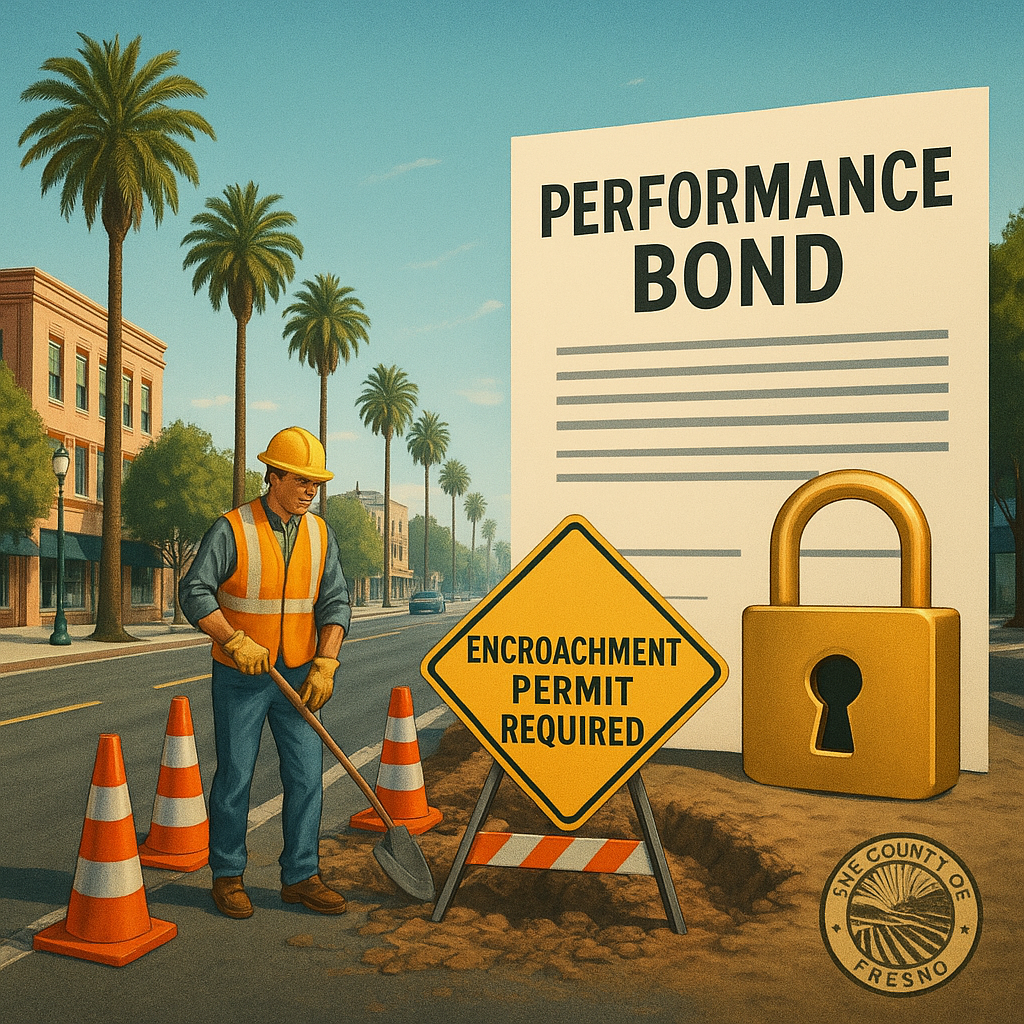
You know that moment when you’re finally ready to build that dream driveway, install a new sidewalk, or finally fix that aging sewer line that runs under the street? There’s a ton of excitement, but then the city or county hands you a requirement that sounds like a foreign language: an encroachment permit performance bond. If you’re working in Fresno County, California, this little piece of paperwork can make or break your project timeline. So let’s unpack everything you need to know in plain, everyday English — no legal degree required.
What Exactly is an Encroachment Permit Anyway?
Let’s start with the basics. An encroachment permit is official permission from a local government — in this case, the County of Fresno — to do work within a public right-of-way. Think of a public right-of-way as land that’s owned by the county but used by everyone: roads, sidewalks, curbs, gutters, utility strips, and even the space under the street. If your project touches any of that shared space, you’re “encroaching” on it. You need a permit to make sure the work is done safely, up to code, and without damaging public infrastructure.
Common projects that need a Fresno County encroachment permit include installing or repairing a driveway approach, putting in new water or sewer lines that connect your property to the main line under the street, building a retaining wall near a sidewalk, or even landscaping that could affect drainage in the public right-of-way. If you’re not sure whether your project needs one, it’s always smart to ask the Fresno County Public Works and Planning department directly. Guessing wrong can lead to stop-work orders and fines that nobody wants.
Why Does Fresno County Require a Performance Bond?
Here’s where the “performance bond” part comes in. A permit just says you can do the work. But how does the county know you’ll finish it correctly and not leave a mess behind? That’s the bond’s job. A Fresno CA encroachment permit performance bond acts like a financial promise. It guarantees that you (the permit holder) will complete all required improvements and repairs within the public right-of-way according to the county’s standards, on time, and without defects.
Think of it as a security deposit, but instead of handing cash to the county, you purchase a bond from a surety company. If you fail to hold up your end of the deal — maybe the concrete work starts crumbling after six months, or you abandon the project halfway through — the county can call on that bond to pay for someone else to fix it. It protects taxpayers and everyone who uses that public space. For you, it’s a way to show you’re serious and capable of doing the job right.
Fresno County’s Specific Bond Requirements: What You Need to Know
Every jurisdiction has its own little tweaks to the rules. Fresno County’s encroachment permit performance bond requirements are typically enforced by the Department of Public Works and Planning. While the exact bond amount can vary depending on the scope of your project, the county will usually calculate it based on the estimated cost of the public right-of-way improvements. Often, the bond amount is set at 100% of that estimated cost, though sometimes it can be higher for more complex jobs.
You can’t just pick a random dollar figure. The county engineer or the inspector assigned to your permit will determine the bond amount after reviewing your plans. For a simple residential driveway approach replacement, the bond might be relatively small — maybe a few thousand dollars. But if you’re putting in a long sewer lateral that requires cutting into a major arterial road, the bond amount can jump significantly. Always wait for the official determination before you shop for a bond; buying the wrong amount just creates delays.
Another key requirement: the bond must be issued by a surety company licensed to do business in California. The bond form also needs to be filed directly with the County of Fresno. Some permits might require the bond to stay in effect for a certain period after the final inspection, often one to two years, to cover any latent defects. That means you can’t simply cancel the bond the day you finish paving.
What Happens If You Don’t Get the Bond?
This isn’t a step you can skip. The county won’t issue your encroachment permit without an approved performance bond in place. Attempting to start work without a valid permit and bond can lead to immediate suspension of your project, heavy administrative fines, and being liable for any damage you cause. It’s just not worth the risk. Even if you’re a contractor doing work for a homeowner, it’s usually the permit holder’s responsibility to secure the bond — so make sure that detail is crystal clear in your contract.
How to Get a Fresno CA Encroachment Permit Performance Bond
The process isn’t as scary as it sounds. It’s a lot like getting insurance. You’ll work with a surety bond agency that specializes in these kinds of bonds. Here’s a step-by-step pathway that can save you a lot of head-scratching:
- Get your permit application ball rolling first. You’ll need the county’s written determination of the required bond amount. Don’t try to guess it; wait for official word.
- Reach out to a reputable surety bond provider. Look for companies that clearly understand California municipal bonds, and specifically Fresno County’s requirements. A local agent can be a huge asset because they know the forms and the people involved.
- Share your project details and county paperwork. The surety will ask about the bond amount, the project description, and sometimes your personal credit. For smaller bonds, underwriting is often quick and straightforward. For larger amounts, they might need financial statements or business information.
- Pay the premium and get your bond. The premium is the cost you pay for the bond, and it’s a percentage of the total bond amount. Once paid, you’ll receive the official bond document.
- File the bond with Fresno County. Usually the bond agency can handle this or guide you on exactly where to send it. The bond needs to be on file before your permit is officially issued.
What Does a Fresno Encroachment Bond Cost?
You’ll often hear about bond premiums being 1% to 3% of the bond amount for applicants with good credit, but that range can stretch up to 5% or even 10% if your credit history is rocky. For a $10,000 bond, a 2% premium means you’d pay $200. If you’re a contractor regularly pulling these permits, building a relationship with a surety agency can lead to better rates and faster service. Remember, you’re paying the premium, not the full bond amount. It’s a fee for the guarantee, not a cash deposit you get back.
Common Misconceptions That Trip People Up
Let’s clear up a few things we hear all the time. First, a performance bond is not the same as a contractor license bond. Your state license bond protects the public from poor workmanship generally, but Fresno County still wants a project-specific bond for encroachments. Having one doesn’t cancel out the other.
Second, the bond is not a substitute for insurance. If you accidentally hit a gas line or damage someone’s property, the performance bond typically won’t cover that — you’d need liability insurance. The bond is solely about completing the permitted public right-of-way work according to county standards.
And third, the bond requirement applies whether you’re a seasoned contractor or a homeowner doing a DIY repair. The county cares about the work, not your resume. So if you’re the hands-on homeowner borrowing a backhoe, be ready to meet the same bonding requirements as a large construction firm.
Real-Life Scenarios: How the Bond Protects Everyone
Imagine a homeowner hires a contractor to widen their driveway approach. The contractor pulls the encroachment permit, posts a $5,000 performance bond, and does the work. A few months later, heavy rain reveals the new concrete wasn’t sloped correctly, and water is pooling on the sidewalk, creating a slipping hazard. The homeowner calls the contractor, but the contractor has gone out of business. Now what? Because of that performance bond, the county can file a claim, get the money, and hire a new crew to fix the dangerous slope. The homeowner isn’t stuck with a lawsuit or an unsafe sidewalk, and taxpayers aren’t footing the bill.
Or picture a developer putting in a new subdivision. They need to tie water and sewer lines into the county mains, which means tearing up a county road. The performance bond ensures that once they’re done, the road is repaved to like-new condition. If they cut corners and the asphalt starts sinking, the county has financial backing to make it right. It’s a safety net that’s easy to overlook until you need it.
Tips for a Smooth Bonding and Permitting Process
Nobody wants to spend weeks chasing paperwork. Here’s how to keep things moving quickly:
- Start early. Even a simple bond can take a day or two to issue. Complex ones can take a week. Factor that into your project schedule.
- Double-check the bond form requirements. Fresno County may have a specific bond form that must be used. If your agent uses a generic template, the county might reject it. Ask the county or your agent for the exact form number.
- Communicate changes promptly. If your project scope expands and the county increases the required bond amount, you’ll need to amend or replace the bond. Keeping everyone in the loop avoids embarrassing delays on the job site.
- Hang on to documentation. Keep copies of the permit, the bond, and all inspection reports. If a dispute ever arises, you’ll want easy access to those records.
- Work with a local expert. A surety agent who regularly handles Fresno County encroachment bonds will know the inspecs, the common snags, and the fastest path to approval.
Wrapping It All Up Without the Headache
Understanding Fresno CA encroachment permit performance bond requirements doesn’t need to feel overwhelming. At its heart, it’s about making a promise — backed by a financial guarantee — that the work you do in public spaces won’t cause problems down the road. The County of Fresno just wants to keep roads safe and infrastructure sound, just like you want to protect your property and your investment.
As you move forward, treat the bond not as a bureaucratic hurdle but as a tool that helps everyone sleep better at night. Once it’s in place, you can break ground with confidence, knowing you’ve checked that crucial box. And if you’re ever uncertain, tap into local resources. The Fresno County Department of Public Works and Planning and a knowledgeable surety professional are your best allies. They’ve likely handled a project just like yours hundreds of times. So take a breath, gather your project details, and get that bond locked in — your future self, and your neighbors, will thank you.